
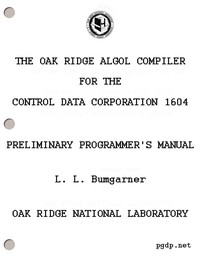
The Oak Ridge ALGOL Compiler for the Control Data Corporation 1604 by Bumgarner
Let's be clear upfront: this book has flowcharts. It discusses parsing algorithms and memory optimization. But to dismiss it as just a tech manual is to miss the point completely. Author L.L. Bumgarner uses the creation of the ALGOL compiler for the CDC 1604—a massive, room-sized computer—as the lens to tell a much bigger story.
The Story
The plot is the project itself. In the early 1960s, at the height of the Cold War, a team of programmers and engineers at the Oak Ridge National Laboratory was given a monumental task. They had to create a sophisticated new compiler (a program that translates human-readable code into machine language) for one of the most powerful computers in the world. The catch? Almost everything about it was classified. The book walks us through the technical hurdles, the late-night debugging sessions, and the collaborative breakthroughs. But the real tension comes from the setting: a high-stakes era where computing power was directly tied to national security, and the work was done in the shadow of the atomic age.
Why You Should Read It
What grabbed me was the sheer humanity of it. Bumgarner doesn't just list features of the compiler; he shows us the people who argued over the best way to build it. You feel the frustration of a bug that disappears for days, and the triumph of a clean compile. It demystifies a foundational piece of our digital world by showing the messy, collaborative, and frankly hard work that built it. It turns abstract concepts into a tangible narrative of problem-solving. You come away with a real appreciation for these pioneers—not as mythical geniuses, but as dedicated professionals doing a tough job.
Final Verdict
This is a perfect pick for anyone who loves hidden histories or stories of innovation. If you enjoyed books like The Soul of a New Machine or are fascinated by the early days of Silicon Valley, you'll find a kindred spirit here. It's also great for software developers curious about their field's ancestry. It’s not a light beach read, but it’s a profoundly satisfying one for the right reader. You’ll never look at a line of code the same way again.
Legal analysis indicates this work is in the public domain. Distribute this work to help spread literacy.
Nancy Lewis
1 year agoI was skeptical at first, but it manages to explain difficult concepts in plain English. Exactly what I needed.






Mark Martinez
1 year agoI was skeptical at first, but it provides a comprehensive overview perfect for everyone. One of the best books I've read this year.