1

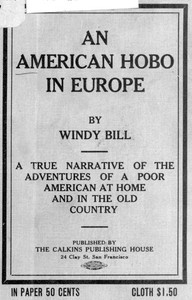
An American Hobo in Europe A True Narrative of the Adventures of a Poor American at Home and in the Old Country — A Closer Reading
(0 User reviews)
317
Project Gutenberg
2014
Not confirmed
Voyages and travels; San Francisco (Calif.) -- Description and travel; Ocean travel; New York (N.Y.) -- Description and travel; Tramps; Glasgow (Scotland) -- Description and travel
Readers of public-domain and historical texts
Project Gutenberg digital edition
en
Edition facts
Words
55,750
Reading time
243 min
Text sections
6
The source record for An American Hobo in Europe A True Narrative of the Adventures of a Poor American at Home and in the Old Country — A Closer Reading measures this digital text at 55,750 words, 4 hr 3 min estimated reading time, and 6 detected text sections.
The text analysis averages about 17.1 words per sentence, while the detected sections provide another way to judge how the source is divided.
Project Gutenberg metadata also associates the work with “Voyages and travels,” connecting these edition facts with the source record’s subject description.
Source:
Project Gutenberg record #45306
Ben Goodkind's 1907 travel narrative, written under the pseudonym Windy Bill, recounts a poor American's adventures from San Francisco to Glasgow via steerage, blending hobo slang with sharp observations of class and publishing rejection.
Read the complete public-domain text at its original source.
Read on Project GutenbergWindy Bill, the narrator of An American Hobo in Europe, introduces himself and his companion Billy with a casual, colloquial voice that sets the tone for the entire narrative. The opening chapter, “Billy and Me,” describes their friendship as closer than brothers and their shared life “on the bum” prospecting in Utah, Nevada, and California. The prose is direct and unpolished, peppered with phrases like “goo-goo eyes” and “trouble be blowed,” signaling a narrator who is neither refined nor apologetic. This voice persists through the excerpts, from a failed attempt to sell his manuscript to New York publishers—who dismiss travel books as “a drug on the market”—to his work as a window-cleaner at a fancy catering house, where he savors “left over victuals” of roast goose and crab salad. The catalog subjects list “Tramps” and “Voyages and travels,” but the excerpts reveal a specific, lived-in perspective: that of a self-described “poor and obscure” man navigating both American and European landscapes on a shoestring.
A Narrator Who Names Himself “Windy”
The narrator’s self-chosen moniker, Windy Bill, is the first clue to the book’s tone. In the excerpts, he is loquacious, opinionated, and unafraid to editorialize. When a ticket agent asks if he is “thinking of going to Yurrup,” Windy replies with suspicion: “What do you want to know for?” This exchange, along with his dismissal of the agent’s offer, shows a man who trusts his own judgment over smooth talk. His voice is consistent—colloquial, sometimes crude, and always aware of his low status. He describes his job cleaning windows at Berry’s as “the softest snap I had ever struck,” and boasts of the fine board while noting the class divide: “The nobs of New York … can have anything they want, providing they have the price to pay for it.” The catalog subject “Tramps” is accurate, but the excerpts show that Windy’s tramping is as much about attitude as economics; he is a proud, sharp-eyed observer who refuses to be humbled.
The Steerage as a Class Marker
When Windy books passage to Glasgow, he insists on steerage: “Steerage, of course; I’m no Vanderbilt.” This line encapsulates the book’s preoccupation with class. The excerpts do not describe the voyage itself in detail, but the decision to travel steerage is presented as both a financial necessity and a point of identity. Earlier, in New York, Windy works among the “nobs” but remains separate from them, cleaning their windows and eating their leftovers. The catalog subject “Ocean travel” is broad, but the excerpts narrow it to a specific experience: the poor man’s crossing. Windy’s encounter with a ticket tout and his careful comparison of fares (“Only thirty dollars”) ground the narrative in concrete, unglamorous logistics. The book’s structure—moving from San Francisco to New York to the Atlantic—suggests a journey defined by economic constraints, not leisure.
Publishing Rejection as a Plot Point
Chapter V, “Them Bloomin’ Publishers,” is a remarkable detour in a travel book. Windy describes trying to sell his manuscript in New York, only to be turned down by every publisher. One editor tells him “there are too many books published nowadays” and that “books of travel were a drug on the market.” Windy’s response is defiant: “The cuss told me everything in the world to discourage me, but he couldn’t do it.” This episode, placed before the ocean voyage, frames the entire book as a vindication. The catalog subjects do not include “Publishers and publishing,” yet the excerpts devote significant space to this rejection. It suggests that An American Hobo in Europe is not just a travelogue but a meta-narrative about the difficulty of getting a poor man’s story into print. Windy’s persistence—and the book’s eventual publication—becomes part of the adventure.
The excerpts offer a fragmented but vivid portrait of a narrator who is both a hobo and a writer. Readers should pay attention to the gaps: the full book likely includes more detailed descriptions of Glasgow, the steerage crossing, and the encounters hinted at in the table of contents, such as “Dancing in the Green” and “Robert Burns, the Poet.” Windy’s voice is the constant—unvarnished, self-aware, and occasionally funny. Approach the text as a document of early twentieth-century class mobility, filtered through a narrator who knows exactly where he stands.
Reading Windy Bill’s steerage complaints, I felt that odd ache of travelling while poor—how the sea looks the same from any deck. It reminded me of another voice, quieter and older, noting similar discomforts in the Low Countries. Records of Journeys to Venice and the Low Countries — A Closer Reading sits beside it on my shelf now, two strangers sharing one weary, wondering gaze.
There are no reviews for this eBook.
There are no comments for this eBook.
Reader reflection
How will you remember this book?
Save your reaction, strongest insight, and memorable passage.
Your progress
0
/
10
2
Was reading this book enjoyable?
3
Would you encourage someone else to read it?
4
How much effort did this book require?
5
How clearly were the main ideas presented?
6
Which part made the strongest impression?
7
Did this book create an emotional response?
8
Could you apply anything you learned?
9
What changed or sharpened your thinking?
10