1

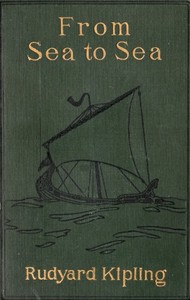
From Sea to Sea; Letters of Travel — Key Ideas to Explore
(0 User reviews)
360
Project Gutenberg
2010
Not confirmed
Voyages and travels; United States -- Description and travel; Asia -- Description and travel; Kipling, Rudyard, 1865-1936 -- Travel
Readers of public-domain and historical texts
Project Gutenberg digital edition
en
Edition facts
Words
218,649
Reading time
951 min
Text sections
23
This digital edition of From Sea to Sea; Letters of Travel — Key Ideas to Explore is described by source-level measurements including 218,649 words, 15 hr 51 min estimated reading time, and 23 detected text sections.
The text analysis averages about 20.3 words per sentence, while the detected sections provide another way to judge how the source is divided.
Project Gutenberg metadata also associates the work with “Voyages and travels,” connecting these edition facts with the source record’s subject description.
Source:
Project Gutenberg record #32977
Kipling's collected travel letters from 1887-1889, covering India, Japan, and America, with sharp observations on colonial life, art, and landscape, marked by a brisk, opinionated voice and shifts between reportage and reflection.
Read the complete public-domain text at its original source.
Read on Project GutenbergKipling's From Sea to Sea collects the special correspondence he wrote for the Civil and Military Gazette and the Pioneer between 1887 and 1889, a period when he was still in his early twenties. The letters move from India through Japan to America, but the book is not a continuous narrative; each piece was originally a standalone dispatch. The voice is consistently brisk, often sardonic, and the prose shifts between detailed reportage and reflective commentary. Kipling frequently addresses the reader directly, as when he notes that "vistas of pillared shade are very pleasant to read about" but that on a cold day one could "cheerfully dispense with a mile or two of it." This tension between aesthetic appreciation and physical discomfort is a recurring note.
The Pace of Travel and the Rhythm of Prose
The letters vary markedly in pace, often mirroring the mode of transport. In the Nikko section, a cart journey is described as "sufficiently exciting" until "the bumpsomeness of the road quenches all emotions save one." The prose itself becomes bumpy: short clauses pile up, mimicking the jolts. Elsewhere, when Kipling lingers over a Hokusai painting, the sentences lengthen and slow, focusing on the "enormous elaboration" of hairpins and the "certainty of touch." The reader can observe how Kipling adjusts sentence length and rhythm to match the scene—hurried when the journey is rough, deliberate when contemplating art. This technique gives the collection a varied tempo that prevents monotony across its 218,000 words.
Voice and the Art of the Aside
Kipling's narrative voice is opinionated and prone to asides. He interrupts descriptions to mock globe-trotters, complain about officials, or offer wry observations. In the preface, he explains that he compiled these pieces to combat "the enterprise of various publishers" who had been reprinting his work with "additions and interpolations." This defensive note colors the collection: Kipling is aware of his audience and his reputation. The letters often include direct addresses to the reader, as when he says of the Nikko avenue, "The avenue took not the least notice of our praise." Such personifications and ironic comments create a conversational tone, but they also reveal a writer self-consciously performing the role of the seasoned traveler. The voice is consistent across the letters, yet it adapts to the subject—more reverent before a Hokusai, more flippant when describing a bumpy cart ride.
Recurring Details: Art, Discomfort, and the Colonial Gaze
Several motifs recur across the letters. One is the encounter with art: the detailed description of the Hokusai painting—the "girl in pale blue and grey crêpe" with a bundle of clothes—shows Kipling's eye for craft and his reliance on expert opinion (the "Japanese Government expert in pictures"). Another is physical discomfort: the cart journey, the cold, the bumps. These details ground the travelogue in bodily experience. A third is the colonial perspective: Kipling often measures foreign scenes against British standards, as when he compares the Japanese pack-ponies' tempers to "Eblis" or notes the "hat-marked caste" in India. These recurring elements—art, discomfort, and the colonial gaze—give the collection a thematic coherence despite its episodic structure. Readers attentive to these patterns will find the letters more unified than they first appear.
Because these letters were written for newspapers, they assume a reader with some knowledge of current events and imperial politics. Kipling rarely explains terms like "the Hat-marked caste" or "the Bhumia of Jhaswara." A reader unfamiliar with late-nineteenth-century India may benefit from a historical glossary. The letters are best read in short bursts, matching their original serial format. Pay attention to the shifts in tone—from awe to irritation, from detailed observation to sweeping generalization—as these reveal Kipling's developing style and his complex attitude toward the places he visits.
I have spent many evenings with From Sea to Sea, yet one quiet thought keeps returning: the way Kipling’s brisk, impatient voice still aches beneath its confidence. That same ache, that travels worn into patience, lives in the old, slow pages of Travels into North America, Volume 1 (of 3) — Reading Companion. Both men kept journals, but only their loneliness remains essential.
There are no reviews for this eBook.
There are no comments for this eBook.
Reader reflection
How did this book work for you?
Your answers remain private and are stored only in this browser.
Your progress
0
/
10
2
What was your overall reaction to the book?
3
Would you recommend this book to another reader?
4
How easy was the book to follow?
5
Did anything about the book feel genuinely new?
6
How useful did the reading feel?
7
Was the book moving at the right speed?
8
How personally connected did you feel to the book?
9
What changed or sharpened your thinking?
10