
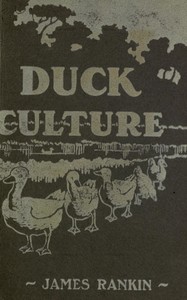
Natural and Artificial Duck Culture by James Rankin
So, what exactly is this book? On the surface, it's a practical manual. James Rankin, a dedicated poultry farmer, wrote it to share everything he learned about raising ducks successfully. He walks you through it all, step-by-step. He starts with the basics: choosing the right breeds (he was a big fan of the Pekin duck), designing the perfect shelter, and creating a healthy pond environment. This is the 'natural' culture he champions—working with the animals' instincts.
The Story
The 'story' is the shift in the book itself. The first half feels like classic, pastoral advice. But then, Rankin pivots to 'Artificial Duck Culture.' This is where he gets into the nitty-gritty of running a duck farm as a business. He details intensive rearing methods, how to force-egg production for maximum yield, and the economics of selling duck down, feathers, and meat to a growing market. The book becomes a blueprint for scaling up, for turning a backyard flock into an industry. You see his passion for the birds slowly get framed by columns of profit-and-loss calculations. It's the journey from farmer to businessman, all within 200 pages.
Why You Should Read It
I loved this book for the perspective it offers. You're not just learning about ducks; you're getting a front-row seat to a changing America. Rankin's voice is sincere and confident, yet there's an almost unconscious melancholy. He's preserving a deep, practical knowledge that was soon to be made obsolete by massive commercial poultry operations. Reading his careful notes on incubators or rail freight costs feels like watching someone build a sandcastle as the tide comes in. It’s a beautiful, detailed record of a hands-on skill that has largely disappeared. It made me think about where our food comes from now versus then, and what we've gained and lost in efficiency.
Final Verdict
This isn't for everyone. If you're looking for a novel, keep moving. But if you're a curious reader who enjoys history, food systems, or forgotten how-to guides, this is a fascinating find. It's perfect for the homesteader dreaming of ducks, the history buff interested in early 1900s agriculture, or anyone who appreciates primary sources that show how people actually lived and worked. It's a quiet, specific, and unexpectedly profound look at a world we've left behind.
There are no legal restrictions on this material. It is available for public use and education.
Christopher Ramirez
1 year agoRecommended.
Logan Rodriguez
1 year agoI didn't expect much, but the storytelling feels authentic and emotionally grounded. Exceeded all my expectations.




Lisa Brown
1 year agoThe index links actually work, which is rare!