
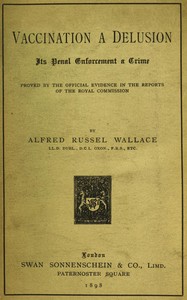
Vaccination a Delusion: Its Penal Enforcement a Crime by Alfred Russel Wallace
Let's set the scene. It's the late 1800s, and smallpox is a terrifying reality. The government has made vaccination against it compulsory, with penalties for those who refuse. Enter Alfred Russel Wallace, co-discoverer of natural selection and a scientific heavyweight. But instead of supporting this public health measure, he publishes a book-length argument trying to blow it out of the water.
The Story
This isn't a story with characters in the usual sense. The main character is the data, and the villain, in Wallace's eyes, is a bad idea enforced by law. Wallace dives deep into decades of public health records from England and other countries. His plot is simple: he lays out his evidence, piece by piece. He compares death rates from smallpox in vaccinated versus unvaccinated populations. He looks at outbreaks in highly vaccinated towns. He argues that sanitation and better living conditions, not the vaccine, caused the drop in smallpox deaths. The central conflict is Wallace versus the entire medical and governmental establishment of his day. He frames compulsory vaccination not as salvation, but as a 'crime'—a violation of personal liberty based on a flawed premise.
Why You Should Read It
Reading this is a profoundly weird experience. You're watching a genius be brilliantly, convincingly wrong. His passion is palpable. He isn't lazy; he's done his homework and presents it with the clarity of a seasoned lecturer. You can feel his outrage at what he sees as statistical manipulation and public deception. It forces you to think: How do we know what we know? How can two people look at the same numbers and see totally different truths? It's a masterclass in persuasive writing from an unexpected source. It doesn't matter if you agree with him (and modern science clearly doesn't). The value is in seeing the anatomy of a major scientific dissent from the inside, argued with intelligence and fiery conviction.
Final Verdict
This book is not for someone looking for a balanced take on vaccine history. It is a one-sided, prosecutorial argument from 1898. But that's exactly why it's so compelling. It's perfect for history buffs who want to go beyond the simple 'science marches on' narrative, for anyone interested in the philosophy of science and how controversies play out, or for readers who just enjoy seeing a formidable intellect locked in a high-stakes debate. Approach it not as a guide, but as a historical artifact—a powerful, persuasive, and ultimately flawed piece of rhetoric from one of science's great minds. It's a challenging, thought-provoking read that will stick with you.
No rights are reserved for this publication. You do not need permission to reproduce this work.
Kevin Nguyen
1 year agoTo be perfectly clear, the clarity of the writing makes this accessible. Thanks for sharing this review.
Amanda Jackson
1 year agoI didn't expect much, but it challenges the reader's perspective in an intellectual way. Exactly what I needed.



Melissa Hernandez
2 years agoIf you enjoy this genre, the clarity of the writing makes this accessible. Exceeded all my expectations.