1

Palmer's Journal of Travels Over the Rocky Mountains, 1845-1846 — Inside the Classic
(0 User reviews)
1046
Project Gutenberg
2014
Not confirmed
Overland journeys to the Pacific; Oregon -- Description and travel; Law -- Oregon; Chinook jargon -- Dictionaries -- English; Nez Percé language -- Dictionaries -- English; Willamette River Valley (Or.) -- Description and travel
Readers of public-domain and historical texts
Project Gutenberg digital edition
en
Edition facts
Words
92,478
Reading time
403 min
Text sections
12
The catalog record for Palmer's Journal of Travels Over the Rocky Mountains, 1845-1846 — Inside the Classic provides practical reading context through 92,478 words, 6 hr 43 min estimated reading time, and 12 detected text sections.
The text analysis averages about 21.6 words per sentence, while the detected sections provide another way to judge how the source is divided.
Project Gutenberg metadata also associates the work with “Overland journeys to the Pacific,” connecting these edition facts with the source record’s subject description.
Source:
Project Gutenberg record #46906
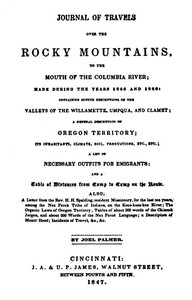
Joel Palmer's 1845-1846 journal records a meticulous overland journey to Oregon, blending practical emigrant advice with ethnographic observations, Native vocabularies, and detailed descriptions of Willamette, Umpqua, and Clamet valleys, alongside Spalding's Nez Percé letter and Chinook jargon.
Read the complete public-domain text at its original source.
Read on Project GutenbergJoel Palmer's journal, published within Reuben Gold Thwaites's Early Western Travels series, is neither a romantic adventure nor a dry itinerary. It is a working document of westward expansion, written by a man who later became Oregon's Superintendent of Indian Affairs. The volume's contents—ranging from a table of distances to a Chinook jargon dictionary—reveal its dual purpose: to guide future emigrants and to record a rapidly changing landscape.
Palmer's eye for practical detail is evident in his descriptions of river navigation, timber quality, and potential mill sites. Yet he also pauses to recount Native traditions, such as the Clatsop story of five pale faces burying something at Cape Lookout, and notes the discovery of beeswax cakes on the beach after storms. These moments suggest a traveler attentive to both the land's utility and its mysteries.
A Journal of Utility and Observation
Palmer's journal is structured as a day-by-day account from April 16, 1845, to July 23, 1846, but it is supplemented with appendices that transform it into a reference work. The Necessary Outfits for Emigrants lists supplies in detail, while the Table of Distances from Independence and St. Joseph to Oregon City provides a practical route. This blend of narrative and handbook suggests Palmer intended his record to serve future travelers, not merely to document his own passage.
His descriptions of the Willamette, Umpqua, and Clamet valleys are precise, noting soil quality, timber types, and navigable waters. For instance, he observes that Young's River is navigable for steamboats to the forks, and that a shingle machine has been erected near a tributary, indicating early industrial activity. Such details ground the journal in economic possibility.
Encounters with Language and Tradition
The volume includes two linguistic appendices: Words used in the Chinook Jargon and Words used in the Nez Percé Language, each containing roughly 200-300 entries. These are not scholarly grammars but practical word lists, likely compiled for traders and settlers. Palmer also incorporates Native place names and terms into his narrative, such as "tilicums" (people) and "Kilamook's Head."
More striking are the traditions he records. The Clatsop story of five white men who came ashore at Cape Lookout, married Native women, and "raised a nation of people" is presented without dismissal. Palmer adds that travelers have reported seeing a race with "European blood" in the region, and he notes the discovery of beeswax cakes after storms as circumstantial evidence. He does not resolve the mystery but lets the reader weigh the conjecture.
Landscape as Archive: Geology and Memory
Palmer reads the Oregon coast as a palimpsest of natural and human history. He describes Cape Lookout as possibly "the remains of an extinct volcano," notes an ancient crater on Saddle Mountain, and observes that Mount Regnier (Rainier) is still active. These geological observations are interwoven with Native traditions: the rock called Kilamook's Head is said to be the chief of a tribe, surrounded by smaller rocks representing his people.
He also records that "singular carving upon the ledges" at Cape Lookout resembles Chinese hieroglyphics more than anything else seen. This detail, left unexplained, hints at pre-Columbian contact or simply the limits of Palmer's frame of reference. The landscape, for Palmer, is not passive scenery but a repository of stories and evidence, waiting to be interpreted.
Readers approaching Palmer's journal should expect a text that shifts between the pragmatic and the curious. The appendices—especially the Chinook jargon and Nez Percé word lists—reward browsing, as they reveal the linguistic landscape of the Oregon Territory. Palmer's voice is that of a careful observer who records what he sees and hears without forcing a single narrative. The journal is best read as a collection of fragments: distances, vocabularies, traditions, and timber reports, each offering a piece of the larger story of westward travel and encounter.
Palmer's tidy volume holds the same patient curiosity I find in Maximilian, Prince of Wied's, Travels in the Interior of North America, 1832-1834, part 1 — Background and Themes. Both men wrote down everything—every river, every root, every word spoken—as if the world itself were a quiet conversation worth preserving, one careful page at a time. That shared tenderness lingers with me.
There are no reviews for this eBook.
There are no comments for this eBook.
Reader reflection
What was your reading experience?
Capture what you thought, learned, and would like to remember.
Your progress
0
/
10
2
What was your overall reaction to the book?
3
Is this a title you would suggest to others?
4
How demanding did the text feel?
5
How closely did the book connect with your experience?
6
How would you describe its reading pace?
7
What did you appreciate most?
8
How valuable was this book for your own interests?
9
What is the main idea you are taking away?
10