1

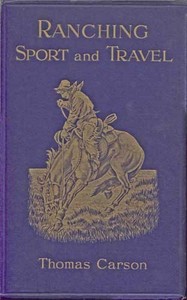
Ranching, Sport and Travel — A Reader’s Guide
(0 User reviews)
514
Project Gutenberg
2007
Not confirmed
Voyages and travels; Arizona -- Description and travel; New Mexico -- Description and travel; Texas -- Description and travel
Readers of public-domain and historical texts
Project Gutenberg digital edition
en
Edition facts
Words
75,436
Reading time
328 min
Text sections
9
Before opening Ranching, Sport and Travel — A Reader’s Guide, the edition data offers a quick orientation: 75,436 words, 5 hr 28 min estimated reading time, and 9 detected text sections.
The text analysis averages about 22.0 words per sentence, while the detected sections provide another way to judge how the source is divided.
Project Gutenberg metadata also associates the work with “Voyages and travels,” connecting these edition facts with the source record’s subject description.
Source:
Project Gutenberg record #20382
Thomas Carson's 1911 memoir blends cattle ranching in Arizona, New Mexico, and Texas with global travels, offering firsthand accounts of cowboy life, prairie fires, and livestock management, grounded in practical detail rather than romanticism.
Read the complete public-domain text at its original source.
Read on Project GutenbergThomas Carson's Ranching, Sport and Travel opens with an introductory note describing the book as 'somewhat in the nature of an autobiography,' yet the catalog subjects—Voyages and travels; Arizona, New Mexico, Texas—only partially capture its content. The first chapter, on tea planting in India, sits uneasily beside the ranching core, hinting at a life divided between continents. Carson, a Fellow of the Royal Geographical Society, writes with the eye of a surveyor: he notes adobe walls 2½ feet thick, the cost of a lease in dollars, and the precise number of cattle in a herd. His prose is unadorned, often technical, and grounded in the logistics of raising stock on the open range.
Cattle as Numbers and Nuisances
Carson treats cattle less as romantic symbols and more as units to be counted, moved, and managed. He records buying '4000 two-year-old steers, all in one straight brand' and later adding 'some 3700 more.' The herd becomes a problem to solve: steers 'walking the fences' in endless circuits until old cows are introduced to settle them. 'The family life seemed complete,' he remarks dryly. The passage reveals a rancher's pragmatism—animals are assets with behavioral quirks. Elsewhere, he notes that lightning killed a dozen cattle that drifted against a fence during a storm. The fence itself, a 'slender wire,' is a recent imposition on a landscape where antelope and ponies alike were ignorant of its danger. Carson’s attention to such details—the cost of a lease, the number of head, the cause of a loss—gives the narrative a ledger-like precision.
Building on the Treeless Plain
The ranch house, built on 'the Spanish plan, of adobes,' is described with the same matter-of-factness as a cattle deal. Walls 2½ feet thick, a courtyard, a roof of boards, mud, and corrugated iron—each layer serves a purpose: cool in summer, warm in winter. 'No other materials are so effective,' Carson asserts. The absence of trees within miles prompts him to haul a cottonwood shoot fifty miles in his buggy and plant it in the court, watering it with 'soap-suddy washings.' The tree thrived, its shade becoming 'the recognized lounging-place.' This small act of transplantation mirrors Carson’s larger enterprise: imposing order on a landscape that offers no raw materials. The adobe house, the imported tree, the fenced pasture—all are deliberate constructions in a setting Carson treats as a blank slate for enterprise.
The Scotsman’s Gamble
Carson’s narrative is punctuated by financial risk. He recalls taking a lease on a 'celebrated steer pasture' in Texas and traveling to Europe to 'float a company,' only to fail and secure a cancellation. The episode is told with retrospective calm, but the anxiety surfaces: 'I began to feel a bit uncomfortable.' A canny Scotsman holding 4000 steers on the free range becomes both obstacle and opportunity. They 'played coon,' Carson writes, until a deal was struck. The language is of bargaining, not adventure. Later, he counts 7700 head into the pasture and prepares to form a company. The reader sees a man who treats ranching as a business venture, not a pastoral idyll. The chapter headings—'My Difficulties and Dangers,' 'Successful Methods'—reinforce this practical orientation. Carson’s world is one of leases, loans, and livestock as capital.
Carson’s book resists easy categorization: part memoir, part manual, part travelogue. Readers expecting a cowboy romance will find instead a record of fence-building, herd-counting, and company-floating. The author’s voice is that of a working rancher who happens also to have traveled the globe. The value of the text lies in its unvarnished detail—the thickness of a wall, the price of a steer, the behavior of cattle under stress. Approach it as a primary document of the American ranching frontier, filtered through the eyes of a British-born entrepreneur.
You know that feeling after a good read, when the dust of a place seems to settle on your memory? Thomas Carson’s memoir has that—he writes about prairie fires and cattle like he’s just telling you a story, no fuss. It lingered with me, much like King Mombo — Inside the Classic does, in that quiet, stubborn way some old voices have.
There are no reviews for this eBook.
There are no comments for this eBook.
Reader reflection
What did you think of this book?
Answer a few questions and save a private reflection on this device.
Your progress
0
/
10
2
Did this book hold your interest?
3
Would you encourage someone else to read it?
4
Did the language feel accessible?
5
Did the book give you something worth debating?
6
Did the book offer a fresh perspective?
7
Could you follow the author’s main argument?
8
Did this book create an emotional response?
9
Which lesson or insight stayed with you?
10