1

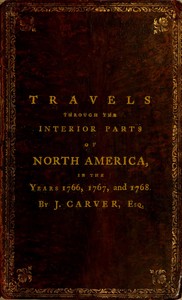
Travels Through the Interior Parts of North America, in the Years 1766, 1767 and 1768 — Story, Setting & Ideas
(0 User reviews)
52
Project Gutenberg
2015
Not confirmed
Indians of North America -- Northwestern states -- Early works to 1800; Ojibwa language -- Glossaries, vocabularies, etc.; Dakota language -- Glossaries, vocabularies, etc.; Northwestern states -- Description and travel -- Early works to 1800; Mississippi River -- Description and travel -- Early works to 1800; Minnesota -- Description and travel -- Early works to 1800
Readers of public-domain and historical texts
Project Gutenberg digital edition
en
Edition facts
Words
109,839
Reading time
478 min
Text sections
35
Before opening Travels Through the Interior Parts of North America, in the Years 1766, 1767 and 1768 — Story, Setting & Ideas, the edition data offers a quick orientation: 109,839 words, 7 hr 58 min estimated reading time, and 35 detected text sections.
The text analysis averages about 32.5 words per sentence, while the detected sections provide another way to judge how the source is divided.
Project Gutenberg metadata also associates the work with “Indians of North America -- Northwestern states -- Early works to 1800,” connecting these edition facts with the source record’s subject description.
Source:
Project Gutenberg record #49753
Jonathan Carver's 1778 travel narrative documents his 1766-1768 journeys through the Great Lakes and Upper Mississippi, blending ethnographic observations of Native nations with natural history, while revealing the tensions between European expectations and Indigenous practices.
Read the complete public-domain text at its original source.
Read on Project GutenbergJonathan Carver's account of his travels through the Great Lakes region and the upper Mississippi Valley from 1766 to 1768 offers a detailed, firsthand perspective on Native American cultures at a moment of intensifying European contact. Carver, a former provincial captain, presents himself as a careful observer, yet his narrative is shaped by the assumptions and limitations of an eighteenth-century British explorer. The text is notable for its ethnographic descriptions, including a chapter on Indian feasts that contrasts Indigenous dietary practices with European norms, and for its inclusion of vocabularies of the Ojibwa and Dakota languages. Carver's observations, while valuable, must be read with an awareness of his cultural biases and the incomplete nature of his encounters.
Dietary Contrasts and Cultural Assumptions
In Chapter VI, Carver describes the eating habits of the Naudowessies (Dakota) and other nations, noting that they neither use bread, salt, nor spices. He remarks that they eat wild rice boiled alone, and consume maple sugar by itself, without using it to sweeten other foods. Carver is struck by the absence of milk in their diet, despite the availability of buffalo and elk, and observes that they consider milk only proper for the young of those animals. He admits that he could not perceive any inconveniency from the disuse of articles esteemed so necessary by Europeans, and notes that the Indians are in general healthy and vigorous. This passage reveals Carver's struggle to reconcile his own cultural expectations with the apparent well-being of the people he observes. He also describes a dish called Succatosh, made from unripe corn and beans boiled with bear's flesh, which he finds extremely palatable. Carver's attention to such details provides a window into Indigenous foodways, but his framing often implies a hierarchy of civilization.
Hospitality and Social Customs
Carver emphasizes the hospitality of the Indians, stating that no people are more hospitable, kind, and free. He notes that they will readily share the last part of their provisions with any of their own tribe, and even with those of a different nation, if they chance to come in when they are eating. This observation counters European stereotypes of savagery, yet Carver also records that the lower ranks are exceedingly nasty in dressing their victuals, while some chiefs are very neat and cleanly. Such distinctions suggest a social hierarchy that Carver is attuned to. He also describes the practice of dancing before or after every meal, which he interprets as a cheerful sacrifice to the Great Spirit, more acceptable than a formal thanksgiving. The separation of men and women at feasts, but their eating together in domestic settings, further illustrates the complexity of social norms that Carver attempts to document.
Linguistic and Ethnographic Gaps
Carver includes vocabularies of the Ojibwa and Dakota languages, reflecting an interest in linguistic documentation that was typical of Enlightenment-era travelers. However, his account also reveals gaps in his knowledge. For instance, he describes a bark that the Naudowessies eat in the spring, but admits he could neither learn the name of it nor discover from whence they got it. He notes that it was of a brittle nature, easily masticated, and in flavor not unlike a turnip. This admission of ignorance is rare in Carver's narrative, which often presents itself as authoritative. Similarly, his description of the Naudowessies' use of a forcible aspiration sounding like an union of the letters OAH at the end of periods indicates an attempt to capture phonetic details, but the transcription is necessarily imprecise. These moments remind the reader that Carver's account is filtered through his own perceptions and the limitations of cross-cultural communication.
Carver's Travels is a document of its time, offering a blend of observation and assumption that rewards careful reading. Readers should attend to the moments where Carver notes what he does not know, as these often reveal the limits of his perspective. The text is best approached as a primary source for understanding how an eighteenth-century British traveler interpreted the peoples and landscapes of the interior, rather than as an objective record. The inclusion of language glossaries and descriptions of daily life provides valuable data, but always within the framework of Carver's own cultural lens.
Reading about Carver’s patient waiting at the portages brought back a train ride I once took through the Dakotas, watching the plains blur into sameness. It felt like the land was holding its breath. Later, Aspects of nature, in different lands and different climates (Vol. 2 of 2) with scientific elucidations — Reading Companion gave me that same quiet sense of being small inside a vast, breathing system.
There are no reviews for this eBook.
There are no comments for this eBook.
Reader reflection
Take a moment to reflect on this book
Create a short personal record of your experience with this book.
Your progress
0
/
10
2
How did the book work for you overall?
3
Would you pass this book on to a friend?
4
How demanding did the text feel?
5
Did it raise ideas you would like to talk about?
6
How well did it match your expectations?
7
Did this book create an emotional response?
8
Could you follow the author’s main argument?
9
Which lesson or insight stayed with you?
10