1

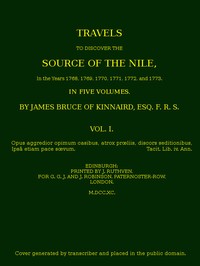
Travels to Discover the Source of the Nile, Volume 1 (of 5) In the years 1768, 1769, 1770, 1771, 1772 and 1773 — Reading Companion
(0 User reviews)
230
Project Gutenberg
2017
Not confirmed
Nile River; Ethiopia -- Description and travel; Egypt -- Description and travel; Natural history -- Ethiopia; Ethiopia -- History
Readers of public-domain and historical texts
Project Gutenberg digital edition
en
Edition facts
Words
173,800
Reading time
756 min
Text sections
17
The catalog record for Travels to Discover the Source of the Nile, Volume 1 (of 5) In the years 1768, 1769, 1770, 1771, 1772 and 1773 — Reading Companion provides practical reading context through 173,800 words, 12 hr 36 min estimated reading time, and 17 detected text sections.
The text analysis averages about 31.2 words per sentence, while the detected sections provide another way to judge how the source is divided.
Project Gutenberg metadata also associates the work with “Nile River,” connecting these edition facts with the source record’s subject description.
Source:
Project Gutenberg record #54180
James Bruce's 1790 travel narrative recounts his journey through Egypt and Ethiopia, blending precise nautical observations with tense encounters and a self-aware, often wary narrative voice.
Read the complete public-domain text at its original source.
Read on Project GutenbergJames Bruce’s 1790 narrative opens with a dedication that frames exploration as a humane, scientific pursuit, contrasting sharply with the wary, survival-minded voice that emerges in the travelogue proper. The excerpts show a narrator who is both a meticulous recorder of coastal geography—noting islands, soundings, and the accuracy of maps—and a man who, when ashore, quickly retreats from a potentially dangerous encounter with an armed, nearly naked Arab. This tension between systematic observation and personal vulnerability shapes the volume’s pace.
A Narrator of Two Minds
The dedication to King George III presents exploration as an enlightened enterprise, but the journal entries reveal a more guarded sensibility. When Bruce lands to hunt antelopes, he is startled by a man who appears silently behind him. His response—claiming to be an Abyssinian slave and then hurrying back to the boat—shows a narrator who adapts his identity to the situation. The prose shifts from measured description of islands and winds to terse, anxious action: “I set out as quickly as possible to the boat.” This double voice—the confident geographer and the cautious traveler—gives the narrative an unsettled rhythm.
The Texture of Daily Travel
Bruce’s account is built from concrete, often mundane details that accumulate into a vivid sense of place and pace. He records the distance sailed (twenty-one leagues), the condition of the vessel (“made some water”), and the behavior of the wind (“blew but faintly”). He notes the names of landmarks—Susange el Bahar, Kalaat el Moilah—and the quality of fish that “shrank away to nothing except skin” when roasted. These observations are not merely decorative; they anchor the narrative in the physical realities of eighteenth-century travel, where progress depended on weather, repairs, and the availability of fresh food.
Encounters and Unease
The encounter with the Arab near Jibbel Shekh is the most dramatic episode in the excerpts, and Bruce’s handling of it reveals his narrative instincts. He describes the man’s appearance with precision—“half a yard of coarse rag only wrapt round his middle, a crooked knife”—and reports their exchange in direct dialogue. But the scene is also marked by what is left unsaid: Bruce never explains why he felt compelled to lie about his identity, and he ends the episode with a dry remark about being “perfectly content with the distance.” The reader is left to infer the threat, a technique that gives the passage its tension.
Readers approaching this first volume should attend to the interplay between Bruce’s scientific ambitions and his personal wariness. The narrative moves between the measured cadence of a logbook and the quicker pulse of a man who knows when to retreat. The excerpts offer only a partial view of the journey, but they suggest a work that is as much about the traveler’s state of mind as about the geography he set out to document.
There’s something touching about how Bruce keeps his doubts close, trusting his own eyes even when the map insists otherwise. That same wary patience seems to live on in the Mekong explorers, who measured miles and unease in equal measure. I think of them sometimes, both sets of travelers, when I reread Travels in the Central Parts of Indo-China (Siam), Cambodia, and Laos (Vol. 2 of 2) During the Years 1858, 1859, and 1860 — A Closer Reading. Their footsteps feel familiar, somehow.
There are no reviews for this eBook.
There are no comments for this eBook.
Reader reflection
Before you leave, reflect on the book
Use these questions to collect your thoughts before moving on.
Your progress
0
/
10
2
How did the book work for you overall?
3
Would you pass this book on to a friend?
4
How easy was the book to follow?
5
Would you like to discuss this book with someone?
6
What was the strongest part of the book?
7
Was the book moving at the right speed?
8
How would you rate its originality?
9
Which lesson or insight stayed with you?
10