1

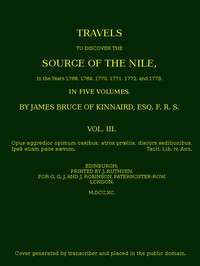
Travels to Discover the Source of the Nile, Volume 3 (of 5) In the years 1768, 1769, 1770, 1771, 1772 and 1773 — A Reader’s Guide
(0 User reviews)
272
Project Gutenberg
2017
Not confirmed
Nile River; Ethiopia -- Description and travel; Egypt -- Description and travel; Natural history -- Ethiopia; Ethiopia -- History
Readers of public-domain and historical texts
Project Gutenberg digital edition
en
Edition facts
Words
223,161
Reading time
971 min
Text sections
20
The catalog record for Travels to Discover the Source of the Nile, Volume 3 (of 5) In the years 1768, 1769, 1770, 1771, 1772 and 1773 — A Reader’s Guide provides practical reading context through 223,161 words, 16 hr 11 min estimated reading time, and 20 detected text sections.
The text analysis averages about 33.9 words per sentence, while the detected sections provide another way to judge how the source is divided.
Project Gutenberg metadata also associates the work with “Nile River,” connecting these edition facts with the source record’s subject description.
Source:
Project Gutenberg record #54531
James Bruce's third volume recounts his journey from Masuah to Gondar, detailing Abyssinian customs, political intrigues, and a thwarted attempt to find the Nile's source, with sharp observations on landscape and local testimony.
Read the complete public-domain text at its original source.
Read on Project GutenbergJames Bruce’s third volume opens with a frank assessment of Abyssinian testimony: the locals claim forty-five inhabited islands in Lake Tzana, but Bruce counters that they are “very great liars” and estimates only eleven. This skeptical voice runs through the narrative, as Bruce constantly weighs local reports against his own measurements. The volume covers his journey from the coast at Masuah up to the highland capital Gondar, then follows the king’s army through marches, battles, and a memorable passage of the Nile. Bruce’s attention to practical detail—the shrinking of the lake from October to March, the forced marches that emptied towns—gives the travelogue a concrete, almost logistical texture.
A Skeptical Eye on Lake Tzana
Bruce’s description of Lake Tzana reveals his method: he notes the lake’s dimensions, its seasonal shrinkage, and the rivers that feed it “like radii drawn to a center.” But he immediately undercuts the Abyssinian claim of forty-five islands, saying “I conceive the number may be about eleven.” He names the principal islands—Dek, Halimoon, Briguida, Galila—and explains their use as prisons or retreats. Then he recounts a telling anecdote: the queen entrusted 1,300 ounces of gold to the governor of Dek, a man of “extraordinary sanctity” who had fasted for forty years, yet that priest stole the gold and fled. The queen refused to pursue him. This story encapsulates Bruce’s blend of geographical observation and wry commentary on local credulity and power.
The King’s March and the Terror of Ras Michael
Bruce tracks the king’s forced march from Tedda to Lamgué, pressed by messengers from Begemder and Amhara urging action against Fasil. The narrative shifts into a higher gear: “Emfras in a few hours was left quite empty” as inhabitants fled to the mountains. Bruce compares Ras Michael’s advance to “the approach of the day of judgment,” and quotes a line from Julius Caesar—“Cried havock, and let slip the dogs of war”—to underscore the violence. Yet he also notes the paradox: Michael was “strict and just” in peacetime, securing the roads. This tension between order and terror runs through the volume, as Bruce observes how military necessity overrides normal life.
The Nile’s Course and the Unreliable Witness
Bruce’s primary goal—discovering the Nile’s source—is woven into the political narrative. He describes the river’s path through Lake Tzana, noting that in dry months the lake shrinks, but after rains it swells “into the plain country.” The Nile’s current remains “always visible” as it turns toward Dara. Yet Bruce’s quest is repeatedly frustrated by the exigencies of war. The volume ends with a second journey to discover the source, but the excerpts show how Bruce’s scientific ambitions are constantly interrupted by the demands of local politics. His voice remains that of a measured observer, skeptical of hearsay, but forced to navigate a world where truth is as shifting as the lake’s shoreline.
Readers will find that Bruce’s value lies less in his ultimate discovery than in the density of his observations: the precise dimensions of a lake, the behavior of a river, the customs of a people, and the mechanics of a campaign. He is a narrator who trusts his own eyes and distrusts others’, yet he records both with equal care. This volume rewards attention to its small details—the stolen gold, the empty town, the forced march—as much as to its grand geographical ambitions.
Reading how Bruce’s guides spoke so plainly of rivers and distances, yet withheld what they truly knew of the highlands, reminded me of how uncertain all such accounts feel. There is a similar honesty in the quiet, unhurried observations of Travels into North America, Volume 3 (of 3) — Reading Notes. Both volumes feel like listening to a trusted friend recall a landscape that no longer quite exists.
There are no reviews for this eBook.
There are no comments for this eBook.
Reader reflection
Take a moment to reflect on this book
Create a short personal record of your experience with this book.
Your progress
0
/
10
2
How much did you enjoy the reading experience?
3
How likely are you to recommend this book?
4
How much effort did this book require?
5
Did you relate to its people, ideas, or situations?
6
Could you see yourself revisiting this book?
7
Did any part of the book stay with you emotionally?
8
How did the pace of the book feel?
9
What is the main idea you are taking away?
10