L
Lisa Mays
Guest
- Thread Author
- #1
A Satsuki azalea can look thirsty in the morning and still have roots struggling for air. You water it, watch excess drain from the pot, and wonder whether Kanuma is doing its job or holding too much moisture. The answer depends on more than the name on the bag: particle size, pot depth, the tree's roots, and how quickly its surroundings dry all shape what happens after watering.
Kanuma isn't a drainage material, and it isn't a universal bonsai soil. It's a porous, naturally acidic growing medium whose moisture behavior needs to match the tree and its growing conditions.
Consider a Satsuki azalea in a shallow pot on a warm, breezy patio. Its fine roots need moisture, but a mix that stays saturated can leave too little air around them. A different azalea in a sheltered, humid spot may dry much more slowly. The same Kanuma and watering routine won't necessarily suit both trees.
That's why “fast-draining” and “moisture-retentive” aren't opposites here. Kanuma's pores can hold water, while the spaces between particles can let water move and air reach roots. A soil experiment cited in a Kanuma moisture and drainage guide reports greater water retention for Kanuma than Akadama, alongside slower drainage. Those findings make the practical point: a porous structure doesn't mean the root zone dries immediately.
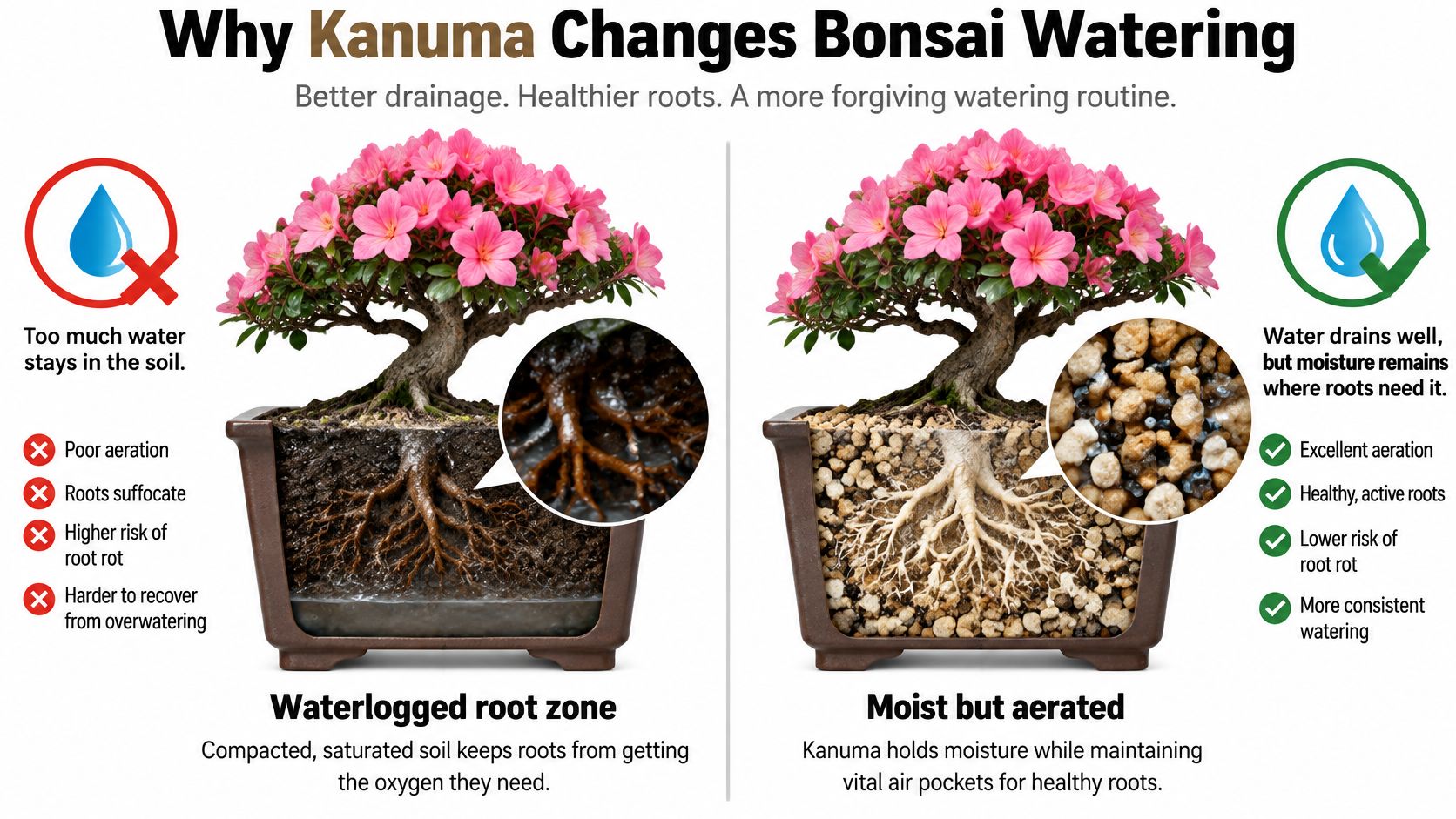
A useful routine is to observe the pot between waterings. If the surface looks dry but the root zone remains damp, don't treat appearance alone as a signal to water. If a shallow pot in wind dries quickly, the same grade may require more frequent checks. The target is a repeatable dry-down that keeps roots moist without leaving the medium persistently wet.
Kanuma is a weathered volcanic-pumice material from the Kanuma area of Tochigi Prefecture, Japan. It isn't a generic mineral mix with an acidic label. Its geological origin helps explain why it has a light, pale appearance and a porous structure that behaves differently from ordinary compacting soil.
Geological accounts connect the deposit to pumice ejected by Mount Akagi roughly 30,000–45,000 years ago, then carried and deposited by wind. Kanuma occurs within the Kanto Loam. One description places the layer approximately 6.5–10 feet below the surface and reports an average thickness of about 3 feet. These geological details are described in an account of the Kanuma deposit and its origins.
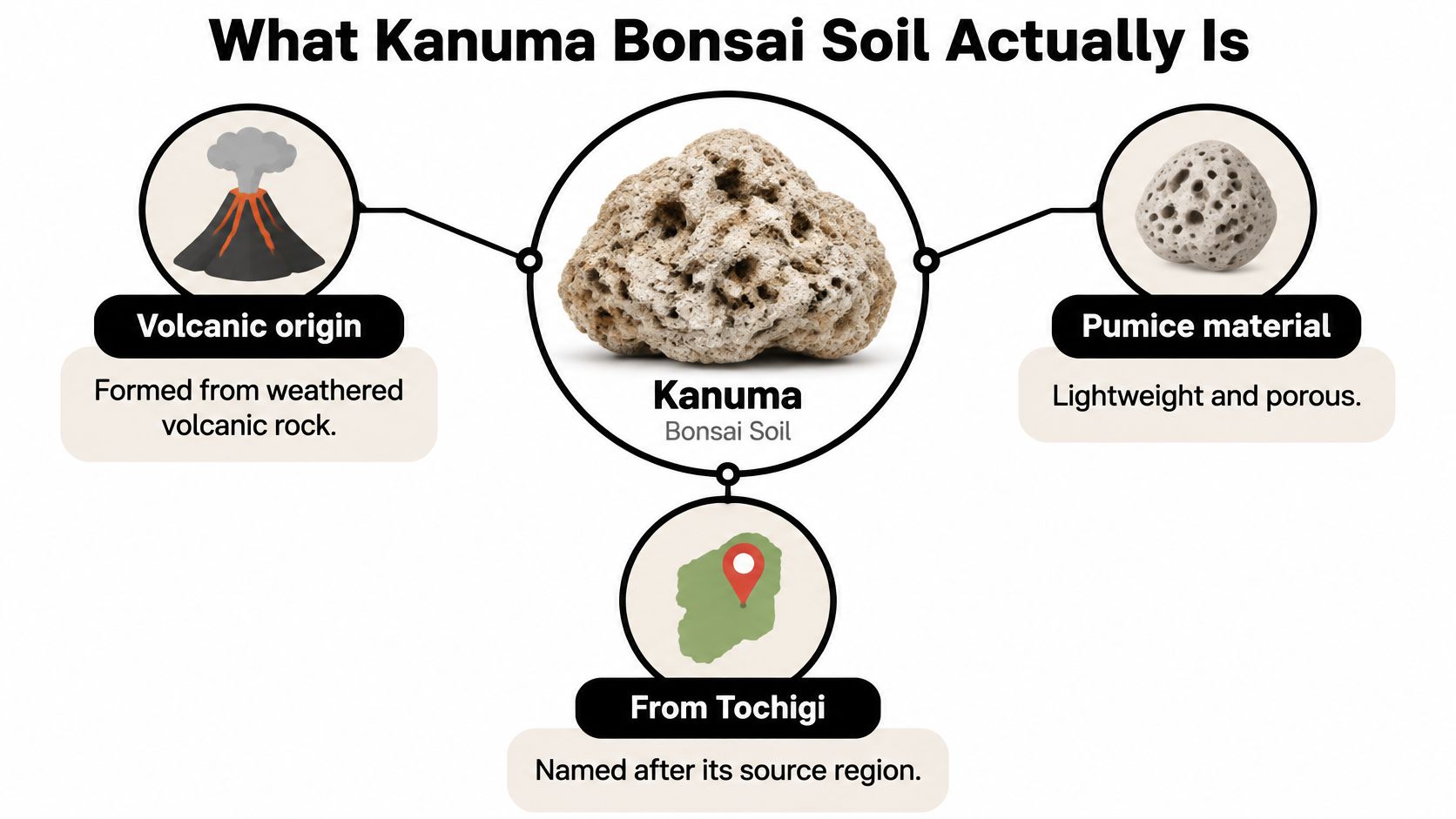
In its natural form, Kanuma particles are described as rounded or irregular and approximately 0.02–0.04 inches across. The material is mined around Kanuma City, a regional production center north of Tokyo, then screened into grades for horticultural use. The particles' shape and internal pores contribute to the distinctive feel of the finished substrate.
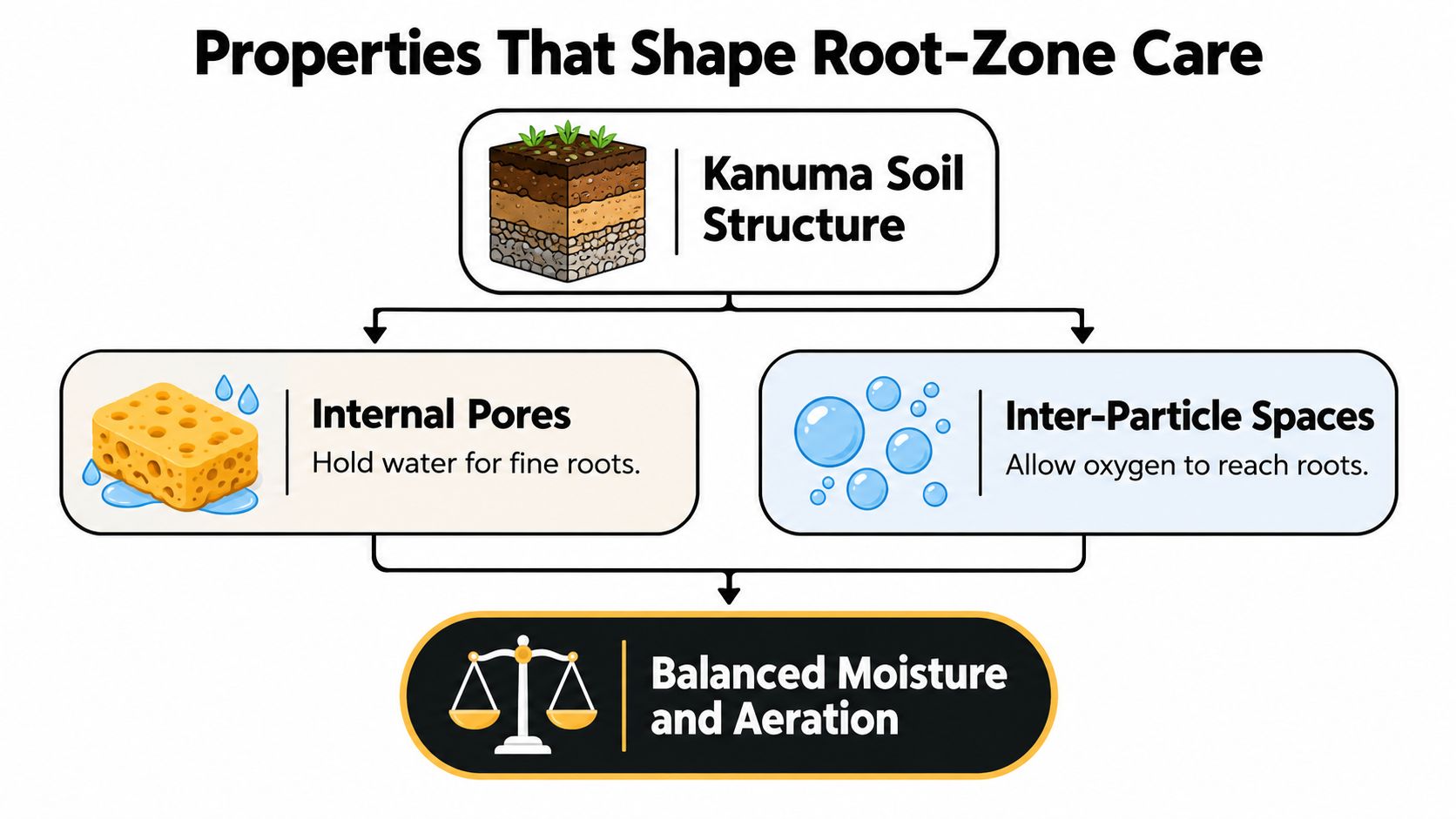
Those pores matter because they help the material do two jobs at once. They can hold water within particles, while the spaces between particles allow air and water to move through the root zone. Weathering is central to that horticultural behavior: growers aren't just buying a volcanic origin story, they're choosing a material whose structure affects moisture around roots.
Kanuma's pale yellow color and low density also help distinguish it from akadama, which is commonly red-brown. The two aren't interchangeable because both are used in bonsai. Kanuma's particular combination of acidity and porosity is one reason it's strongly associated with Satsuki azaleas and other acid-loving bonsai.
The useful takeaway is to think of Kanuma as a specific screened volcanic material, not as a synonym for bonsai soil. Its origin helps explain the physical traits; its grade and the way it's used determine how those traits affect a particular tree.
A bag description can't tell you exactly how a tree's pot will dry. To make a sound choice, consider Kanuma's properties separately, then look at how they interact in the container.
Porosity describes the openings in and around the particles. Internal pores can store moisture for fine roots, while spaces between particles provide routes for air. These aren't contradictory functions. A substrate can hold water and still have air spaces, although the balance changes with particle size, pot depth, root density, and how much the particles have broken down.
Kanuma is naturally acidic. Commercial specifications commonly place it near pH 5, though reported values vary with source and grading, as noted in a Kanuma product specification. That reaction can suit acid-loving plants such as Satsuki azalea, rhododendron, and camellia. For those plants, acidity can also support micronutrient availability.
But acidity isn't an automatic benefit for every bonsai. A tree that prefers near-neutral conditions may not need an acidic medium. If you're choosing a substrate for a species with different pH preferences, consider whether Kanuma is suitable at all, or whether a blend with more chemically neutral aggregate makes better sense.
Drainage isn't a single trait you can assess by pouring water through a handful of material. In a pot, moisture behavior depends on particle size, container depth, roots, the surrounding climate, and the watering routine. Even the irrigation water matters: its alkalinity can affect the acidity maintained around the roots.
For example, a fine-rooted azalea may benefit from moisture held near its roots, while a tree in a damp setting may need a more open mix to dry at a suitable pace. Neither decision follows from pH alone. A sound choice accounts for species, substrate structure, and conditions together, rather than treating one property as a complete care plan.
Choose a grade for the job it needs to do, not because one bag looks more professional than another. The particles should suit the container and root system: material that's too coarse for a small, fine root system may not provide the contact and moisture behavior the roots need, while a finer grade can hold moisture longer and may call for closer attention to dry-down.
For azaleas, a commonly specified grade is approximately 3–6 mm. That's a useful reference rather than a universal prescription. The appropriate choice still depends on the tree, pot, climate, and how you water.
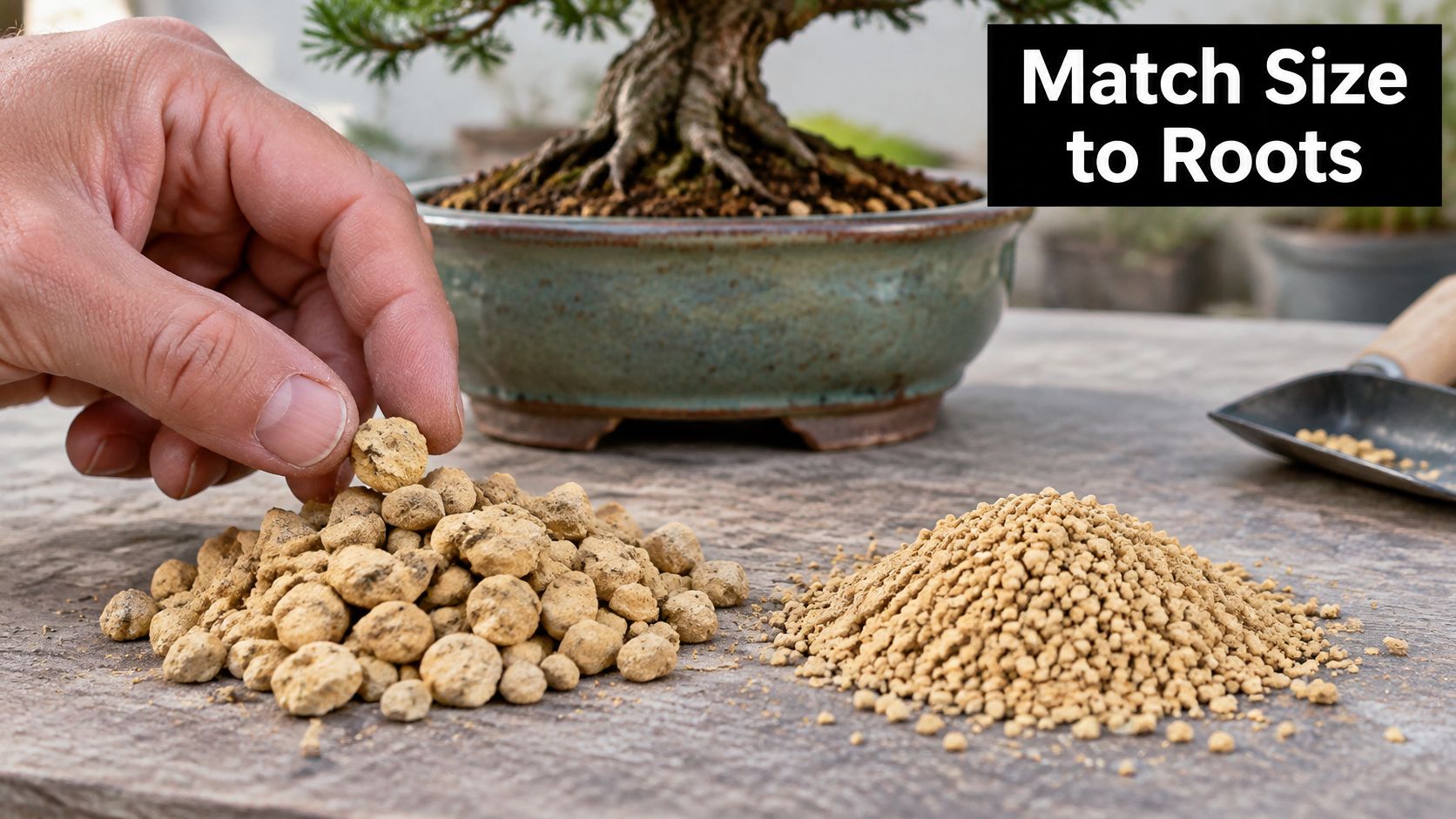
If you're comparing grades, focus on how particle size affects air space and drainage in the container. This guide to how soil particle size affects drainage can help you think through that relationship without assuming that finer or coarser is automatically better.
A blend isn't automatically better than using Kanuma alone. Start by asking what you need to change: moisture around fine roots, faster dry-down, a more open structure, or a less acidic overall medium. Then adjust the substrate based on how the pot behaves, rather than adding components without a clear reason.
For an acid-loving bonsai, selecting a medium is a match between the plant and its growing conditions, not a recipe determined by the species name alone. Use this process to make a practical choice:
A Satsuki azalea is a strong example of a tree for which Kanuma's naturally acidic character can fit the plant's needs. Its porous structure can also help keep moisture available to fine roots. But in a warm, windy spot or a shallow container, check the moisture often rather than assuming the medium will stay wet long enough.
Rhododendron and camellia call for the same careful thinking, not an automatic copy of an azalea mix. Look at each tree's roots, container, local humidity, rainfall, and watering habits. If the site stays damp, consider a more open or blended substrate; if it dries rapidly, assess whether the grade and watering routine provide enough moisture for that tree.
Understanding how soil pH affects nutrient availability can help you evaluate whether an acidic medium suits the plant you're growing. The aim isn't to force every acid-loving species into one formula. It's to select a substrate that respects both the tree's preferences and the conditions around its roots.
“Will Kanuma cause root rot?” doesn't have a simple yes-or-no answer. Porosity doesn't guarantee that a root zone will stay oxygenated in every pot. Particle size, pot depth, root density, watering frequency, humidity, and the condition of the substrate all affect how long it stays wet.
Think of a Satsuki azalea in a shallow pot on a breezy patio, a rhododendron in a sheltered spot, and a camellia growing in a humid greenhouse. Even if all three use Kanuma, their pots may dry at different rates. A fixed schedule would miss those differences, and watering because a particular day has arrived can keep a slow-drying root zone too wet.
After watering, pay attention to the moisture in the substrate, not only its surface. A dry-looking surface doesn't necessarily mean the root zone needs water; a pot that remains damp for longer than expected may need a more open grade or a change to the growing conditions. Check the tree and medium regularly until you understand their pattern, then keep adjusting when weather or growth changes.
If your growing area stays wet, or you tend to water again before the medium has dried appropriately, consider larger particles or a more aerating blend. Finer particles make more sense when the roots and watering routine justify the additional moisture retention. Avoid treating either option as a cure by itself: the aim is a suitable dry-down, not the fastest possible drainage.
The guide to how often to water a bonsai tree offers another way to think about watering as a response to the tree and its conditions rather than a rigid calendar. If Kanuma has broken down into finer material, reassess how the pot drains and holds moisture. As the substrate changes, a routine that once worked may no longer fit.
Buy Kanuma based on a supplier's description, not color alone. A useful listing should explain the material's origin, screened grade, and intended horticultural use. Pale volcanic products can look alike without behaving identically in a pot, so don't assume that appearance confirms the same particle size or moisture behavior.
Keep unused Kanuma dry and separate from other substrates. Use a clean sieve, bucket, and mixing surface so old soil or debris doesn't contaminate a fresh batch. When repotting, check the condition of the old medium. If particles have broken down into finer material, the pot may hold moisture differently and need a revised substrate choice or watering routine.
After potting, observe how the tree and medium respond rather than expecting a particular grade to behave exactly like the previous mix. If water doesn't move through the pot as expected, or the root zone stays wetter than your routine allows, reassess the particle size, blend, container depth, and growing conditions. Make one considered adjustment at a time so you can see what changes.
A healthy setup also depends on appropriate equipment and care. Choose a durable bonsai pot with suitable drainage, use wiring that fits the tree and its styling needs, and select a complementary fertilizer for the plant. Those choices support good cultivation, but they don't replace the central task: keeping the root environment suited to the species.
Leaves & Soul offers purpose-built soils, fertilizers, and bonsai accessories, including durable glazed ceramic pots, wiring kits, and sets for getting started. Explore Leaves & Soul to find supplies that complement your bonsai setup and support your next growing project.
Kanuma isn't a drainage material, and it isn't a universal bonsai soil. It's a porous, naturally acidic growing medium whose moisture behavior needs to match the tree and its growing conditions.
Why Kanuma Changes Bonsai Watering
Consider a Satsuki azalea in a shallow pot on a warm, breezy patio. Its fine roots need moisture, but a mix that stays saturated can leave too little air around them. A different azalea in a sheltered, humid spot may dry much more slowly. The same Kanuma and watering routine won't necessarily suit both trees.
That's why “fast-draining” and “moisture-retentive” aren't opposites here. Kanuma's pores can hold water, while the spaces between particles can let water move and air reach roots. A soil experiment cited in a Kanuma moisture and drainage guide reports greater water retention for Kanuma than Akadama, alongside slower drainage. Those findings make the practical point: a porous structure doesn't mean the root zone dries immediately.
The central material trade-off
| Observed property | What it can mean in the root zone | Practical response |
|---|---|---|
| Porous particles | Moisture can remain inside the particles while air occupies spaces around them. | Check how the whole pot dries, not just whether water runs through. |
| Finer grade | More moisture may stay around small roots, but the mix can dry more slowly. | Use it only when the tree and your watering routine suit that behavior. |
| Larger grade or more open blend | Water may move through more readily and the root zone may dry faster. | Consider it in wet conditions or if you tend to water too often. |
Practical rule: Match the substrate to the tree's roots and its setting. Don't choose Kanuma on the assumption that it automatically prevents overwatering.
A useful routine is to observe the pot between waterings. If the surface looks dry but the root zone remains damp, don't treat appearance alone as a signal to water. If a shallow pot in wind dries quickly, the same grade may require more frequent checks. The target is a repeatable dry-down that keeps roots moist without leaving the medium persistently wet.
What Kanuma Bonsai Soil Actually Is
Kanuma is a weathered volcanic-pumice material from the Kanuma area of Tochigi Prefecture, Japan. It isn't a generic mineral mix with an acidic label. Its geological origin helps explain why it has a light, pale appearance and a porous structure that behaves differently from ordinary compacting soil.
Geological accounts connect the deposit to pumice ejected by Mount Akagi roughly 30,000–45,000 years ago, then carried and deposited by wind. Kanuma occurs within the Kanto Loam. One description places the layer approximately 6.5–10 feet below the surface and reports an average thickness of about 3 feet. These geological details are described in an account of the Kanuma deposit and its origins.
From deposit to growing medium
In its natural form, Kanuma particles are described as rounded or irregular and approximately 0.02–0.04 inches across. The material is mined around Kanuma City, a regional production center north of Tokyo, then screened into grades for horticultural use. The particles' shape and internal pores contribute to the distinctive feel of the finished substrate.
Those pores matter because they help the material do two jobs at once. They can hold water within particles, while the spaces between particles allow air and water to move through the root zone. Weathering is central to that horticultural behavior: growers aren't just buying a volcanic origin story, they're choosing a material whose structure affects moisture around roots.
Kanuma's pale yellow color and low density also help distinguish it from akadama, which is commonly red-brown. The two aren't interchangeable because both are used in bonsai. Kanuma's particular combination of acidity and porosity is one reason it's strongly associated with Satsuki azaleas and other acid-loving bonsai.
The useful takeaway is to think of Kanuma as a specific screened volcanic material, not as a synonym for bonsai soil. Its origin helps explain the physical traits; its grade and the way it's used determine how those traits affect a particular tree.
Properties That Shape Root-Zone Care
A bag description can't tell you exactly how a tree's pot will dry. To make a sound choice, consider Kanuma's properties separately, then look at how they interact in the container.
Porosity describes the openings in and around the particles. Internal pores can store moisture for fine roots, while spaces between particles provide routes for air. These aren't contradictory functions. A substrate can hold water and still have air spaces, although the balance changes with particle size, pot depth, root density, and how much the particles have broken down.
Read acidity alongside structure
Kanuma is naturally acidic. Commercial specifications commonly place it near pH 5, though reported values vary with source and grading, as noted in a Kanuma product specification. That reaction can suit acid-loving plants such as Satsuki azalea, rhododendron, and camellia. For those plants, acidity can also support micronutrient availability.
But acidity isn't an automatic benefit for every bonsai. A tree that prefers near-neutral conditions may not need an acidic medium. If you're choosing a substrate for a species with different pH preferences, consider whether Kanuma is suitable at all, or whether a blend with more chemically neutral aggregate makes better sense.
Judge the whole root environment
Drainage isn't a single trait you can assess by pouring water through a handful of material. In a pot, moisture behavior depends on particle size, container depth, roots, the surrounding climate, and the watering routine. Even the irrigation water matters: its alkalinity can affect the acidity maintained around the roots.
For example, a fine-rooted azalea may benefit from moisture held near its roots, while a tree in a damp setting may need a more open mix to dry at a suitable pace. Neither decision follows from pH alone. A sound choice accounts for species, substrate structure, and conditions together, rather than treating one property as a complete care plan.
Choosing Kanuma Grades and Blends
Choose a grade for the job it needs to do, not because one bag looks more professional than another. The particles should suit the container and root system: material that's too coarse for a small, fine root system may not provide the contact and moisture behavior the roots need, while a finer grade can hold moisture longer and may call for closer attention to dry-down.
For azaleas, a commonly specified grade is approximately 3–6 mm. That's a useful reference rather than a universal prescription. The appropriate choice still depends on the tree, pot, climate, and how you water.
If you're comparing grades, focus on how particle size affects air space and drainage in the container. This guide to how soil particle size affects drainage can help you think through that relationship without assuming that finer or coarser is automatically better.
Choosing a substrate approach
| Approach | Root-zone priority | Best fit | Trade-off |
|---|---|---|---|
| Kanuma alone | Keep the medium aligned with an acid-loving species' requirements. | A suitable acid-loving bonsai when the grade and watering routine fit its conditions. | The mix still needs to be monitored for moisture and dry-down. |
| Kanuma with a more aerating aggregate | Open the structure or encourage faster drying. | Wet conditions, deep moisture retention, or a grower who tends to overwater. | A more open mix may require more frequent moisture checks. |
| Kanuma with a more chemically neutral aggregate | Temper how strongly the substrate reflects Kanuma's acidity. | A tree whose requirements call for a less acidic overall medium. | The blend must still suit the species and preserve a workable root environment. |
| A different substrate | Avoid adding acidity where it isn't needed. | A bonsai whose species requirements don't call for Kanuma. | The alternative must be chosen for that tree's own moisture and aeration needs. |
A blend isn't automatically better than using Kanuma alone. Start by asking what you need to change: moisture around fine roots, faster dry-down, a more open structure, or a less acidic overall medium. Then adjust the substrate based on how the pot behaves, rather than adding components without a clear reason.
Kanuma for Acid-Loving Bonsai Species
For an acid-loving bonsai, selecting a medium is a match between the plant and its growing conditions, not a recipe determined by the species name alone. Use this process to make a practical choice:
- Start with the plant. Satsuki azalea, rhododendron, and camellia are examples of acid-loving bonsai for which Kanuma may be appropriate.
- Consider the roots and pot. Fine roots and a shallow container can change how quickly the root zone dries. A grade suited to one plant may not behave the same way in another container.
- Read the growing conditions. Warmth, wind, humidity, and rainfall all affect moisture loss. A sheltered tree and one exposed to drying conditions won't necessarily need the same watering rhythm.
- Account for irrigation water. Water alkalinity is one factor in deciding whether Kanuma should be used alone or combined with more chemically neutral aggregate.
Apply the same reasoning to each species
A Satsuki azalea is a strong example of a tree for which Kanuma's naturally acidic character can fit the plant's needs. Its porous structure can also help keep moisture available to fine roots. But in a warm, windy spot or a shallow container, check the moisture often rather than assuming the medium will stay wet long enough.
Rhododendron and camellia call for the same careful thinking, not an automatic copy of an azalea mix. Look at each tree's roots, container, local humidity, rainfall, and watering habits. If the site stays damp, consider a more open or blended substrate; if it dries rapidly, assess whether the grade and watering routine provide enough moisture for that tree.
Understanding how soil pH affects nutrient availability can help you evaluate whether an acidic medium suits the plant you're growing. The aim isn't to force every acid-loving species into one formula. It's to select a substrate that respects both the tree's preferences and the conditions around its roots.
Watering and Root-Rot Prevention
“Will Kanuma cause root rot?” doesn't have a simple yes-or-no answer. Porosity doesn't guarantee that a root zone will stay oxygenated in every pot. Particle size, pot depth, root density, watering frequency, humidity, and the condition of the substrate all affect how long it stays wet.
Think of a Satsuki azalea in a shallow pot on a breezy patio, a rhododendron in a sheltered spot, and a camellia growing in a humid greenhouse. Even if all three use Kanuma, their pots may dry at different rates. A fixed schedule would miss those differences, and watering because a particular day has arrived can keep a slow-drying root zone too wet.
The pot tells you more than the calendar. Watch how quickly the substrate moves from freshly watered to ready for another watering.
Use dry-down as your decision signal
After watering, pay attention to the moisture in the substrate, not only its surface. A dry-looking surface doesn't necessarily mean the root zone needs water; a pot that remains damp for longer than expected may need a more open grade or a change to the growing conditions. Check the tree and medium regularly until you understand their pattern, then keep adjusting when weather or growth changes.
If your growing area stays wet, or you tend to water again before the medium has dried appropriately, consider larger particles or a more aerating blend. Finer particles make more sense when the roots and watering routine justify the additional moisture retention. Avoid treating either option as a cure by itself: the aim is a suitable dry-down, not the fastest possible drainage.
The guide to how often to water a bonsai tree offers another way to think about watering as a response to the tree and its conditions rather than a rigid calendar. If Kanuma has broken down into finer material, reassess how the pot drains and holds moisture. As the substrate changes, a routine that once worked may no longer fit.
Sourcing and Maintaining Your Kanuma Supply
Buy Kanuma based on a supplier's description, not color alone. A useful listing should explain the material's origin, screened grade, and intended horticultural use. Pale volcanic products can look alike without behaving identically in a pot, so don't assume that appearance confirms the same particle size or moisture behavior.
Handle and store the material carefully
Keep unused Kanuma dry and separate from other substrates. Use a clean sieve, bucket, and mixing surface so old soil or debris doesn't contaminate a fresh batch. When repotting, check the condition of the old medium. If particles have broken down into finer material, the pot may hold moisture differently and need a revised substrate choice or watering routine.
After potting, observe how the tree and medium respond rather than expecting a particular grade to behave exactly like the previous mix. If water doesn't move through the pot as expected, or the root zone stays wetter than your routine allows, reassess the particle size, blend, container depth, and growing conditions. Make one considered adjustment at a time so you can see what changes.
A healthy setup also depends on appropriate equipment and care. Choose a durable bonsai pot with suitable drainage, use wiring that fits the tree and its styling needs, and select a complementary fertilizer for the plant. Those choices support good cultivation, but they don't replace the central task: keeping the root environment suited to the species.
Leaves & Soul offers purpose-built soils, fertilizers, and bonsai accessories, including durable glazed ceramic pots, wiring kits, and sets for getting started. Explore Leaves & Soul to find supplies that complement your bonsai setup and support your next growing project.