1

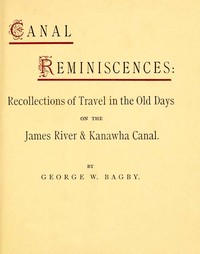
Canal Reminiscences Recollections of Travel in the Old Days on the James River & Kanawha Canal — A Reader’s Guide
(0 User reviews)
53
Project Gutenberg
2020
Not confirmed
Virginia -- Description and travel; Bagby, George William, 1828-1883; Inland navigation -- Virginia; Canal-boats -- Virginia; James River and Kanawha Canal (Va.) -- Navigation
Readers of public-domain and historical texts
Project Gutenberg digital edition
en
Edition facts
Words
9,166
Reading time
40 min
Text sections
3
For Canal Reminiscences Recollections of Travel in the Old Days on the James River & Kanawha Canal — A Reader’s Guide, the stored edition analysis reports 9,166 words, 40 min estimated reading time, and 3 detected text sections.
The text analysis averages about 20.9 words per sentence, while the detected sections provide another way to judge how the source is divided.
Project Gutenberg metadata also associates the work with “Virginia -- Description and travel,” connecting these edition facts with the source record’s subject description.
Source:
Project Gutenberg record #62708
Bagby's 1879 memoir of canal travel on the James River & Kanawha Canal blends personal recollection with a lament for lost prosperity, using a conversational voice and shifting from nostalgic detail to philosophical reflection.
Read the complete public-domain text at its original source.
Read on Project GutenbergBagby opens his preface with a frank complaint: newspapers can no longer pay for contributions, unlike the former days when the Dispatch cheerfully gave him dollars for trifles. This financial anxiety sets the tone for a memoir that is as much about economic decline as about canal travel. The author’s voice is immediately personal and digressive, moving from the hope that a new railway will bring prosperity to a defense of stingy people who pay their debts. The preface frames the canal as an obsolescent mode of travel, and the reminiscences as a pleasure for friends of the publishers and writer.
A Conversational Voice and Its Digressions
Bagby’s narrative voice is that of a genial, loquacious raconteur. He freely interrupts his own recollections with asides about Richmond’s business men, the character of stingy people, and the hope that better times have begun in Troy, N.Y. This digressive style mirrors the unhurried pace of canal travel itself. In the preface, he shifts from the difficulty of getting paid to a defense of close-fisted fellows, then to a general praise of Richmond, all within a few paragraphs. The reader is carried along by the author’s associative logic rather than a strict chronological plan.
Specific Recollections and Their Fragile Hold
Bagby’s memories are precise but fleeting. He recalls a trip from Cumberland County to Lynchburg in 1835, naming figures like Major Yancey, “the wheel-horse of Democracy,” and Tim. Rives, whose face “resembled the inside of a gunlock.” He remembers the family of Captain Huntley, his pretty daughters, and the location of their house next to the Radical Methodist Church. Yet he admits that other forms are “merely outlines barely discernible,” and reflects that men pass away like “shadows gone into shadow-land.” The detail is vivid, but the author is acutely aware of the limits of memory.
Shifts in Pace and Mood
The narrative pace changes markedly in the 1849 passage. Bagby, now a sick graduate with a diploma in a green tin case, describes a night on deck. The prose slows to a lyrical, almost meditative rhythm, with the owl’s “long hoot,” the whippoorwill’s cry, and the “stilly sound” of inanimate nature. The sick boy looks up at the stars, and the tone darkens into a philosophical questioning of heaven and suffering. This shift from brisk anecdote to somber reflection shows Bagby’s ability to modulate his voice, using the canal journey as a frame for both social observation and personal introspection.
The Canal as a Vanished World
Throughout the excerpts, the canal is presented as a world already passing. Bagby notes the effect of the canal in Lynchburg—the array of freight boats, the bustle at the packet landing, and new faces from the canal region of New York. He lists captains and acquaintances, many of whom have since disappeared without a trace. The memoir is a deliberate act of preservation, capturing a mode of travel that was “obsolescent” even as he wrote. The railway, he hopes, will bring prosperity, but the canal’s slow, deliberate pace is what gives his recollections their texture and charm.
Bagby’s Canal Reminiscences rewards a reader willing to follow its digressions. The author’s voice is the real subject: a man looking back with affection and melancholy, aware that his memories are fading. Pay attention to the shifts in tone—from the chatty preface to the lyrical night passage—and to the way Bagby uses specific names and places to anchor his reflections. The canal itself is a backdrop; the journey is through time and mood.
The rain tapped the windows while Bagby’s canal boats drifted past in his words, his fondness for a vanished waterway lingering long after I closed the book. That same quiet ache for lost routes pulled me toward an earlier traveler’s log, with its own patient observations of rivers and wilderness. I sat there, half-listening to the downpour, and picked up Travels Through the Interior Parts of North America, in the Years 1766, 1767 and 1768 — Story, Setting & Ideas, as if one gentle voice naturally led to another.
There are no reviews for this eBook.
There are no comments for this eBook.
Reader reflection
What was your reading experience?
Capture what you thought, learned, and would like to remember.
Your progress
0
/
10
2
Did this book hold your interest?
3
Would you encourage someone else to read it?
4
How easy was the book to follow?
5
How valuable was this book for your own interests?
6
How personally connected did you feel to the book?
7
Did the book meet your expectations?
8
What was the strongest part of the book?
9
In one sentence, what did you learn?
10