1

Mr. Ray's travels, Vol. 2 — Reading Companion
(0 User reviews)
412
Project Gutenberg
2025
Not confirmed
Voyages and travels -- Early works to 1800; Plants -- Classification -- Early works to 1800; Middle East -- Description and travel -- Early works to 1800; Botany -- Pre-Linnean works; Greece -- Description and travel -- Early works to 1800; Africa -- Description and travel -- Early works to 1800
Readers of public-domain and historical texts
Project Gutenberg digital edition
en
Edition facts
Words
197,311
Reading time
858 min
Text sections
83
The source record for Mr. Ray's travels, Vol. 2 — Reading Companion measures this digital text at 197,311 words, 14 hr 18 min estimated reading time, and 83 detected text sections.
The text analysis averages about 32.6 words per sentence, while the detected sections provide another way to judge how the source is divided.
Project Gutenberg metadata also associates the work with “Voyages and travels -- Early works to 1800,” connecting these edition facts with the source record’s subject description.
Source:
Project Gutenberg record #76193
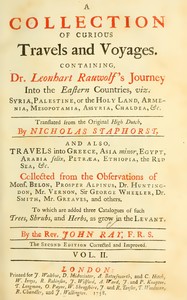
This volume compiles 17th-century travel narratives by Leonhard Rauwolf and others, translated into English, with detailed observations of Eastern Mediterranean cultures, plants, and customs. The text blends natural history with ethnographic description, revealing the authorial choices in diction and structure.
Read the complete public-domain text at its original source.
Read on Project GutenbergThis volume opens with Leonhard Rauwolf's account of his journey from Augspurg to Tripoli, where he immediately attends to the city's "fruitful neighbourhood" and "great trade." The prose shifts between geographical description and practical detail—such as the making of Rusma, pot-ashes, and soap—revealing a methodical observer. Rauwolf's voice is precise, noting the "splendid baths" and "magnificent buildings" with an eye for both utility and ornament. His cataloguing of plants in a separate chapter underscores the work's dual focus: travel as both cultural encounter and botanical survey.
Diction and the Observer's Stance
Rauwolf's language is consistently concrete and sensory. He describes Turkish prayers with physical exactness: "lifting up his hands, stroking over his forehead, bending his whole body forwards, falling down upon his knees, kissing the earth." This sequence of verbs mirrors the ritual's progression, emphasizing bodily posture over theological interpretation. The translator, Nicholas Staphorst, preserves this kinetic quality, avoiding abstract glosses. When Rauwolf notes that during prayers "you shall hear none of them sneeze, cough, hawk or spit," he grounds religious practice in observable behavior. His diction favors the tangible—"lamps," "shops," "victuals"—over the speculative, a choice that aligns with the work's empirical bent.
Structure and the Compilation of Voices
The volume is a composite: Rauwolf's journey forms Part I, followed by travels collected from Belon, Alpinus, and others, and concludes with three catalogues of Levantine plants. This structure reflects John Ray's editorial hand, organizing disparate accounts under a natural-history framework. The chapter headings themselves—"Of the famous city of Tripoli," "Of the Turks of high and low conditions"—signal a taxonomic impulse, treating cities and peoples as specimens to be classified. The shift from narrative to catalogue at the end suggests that the travelogue serves as prelude to systematic botany. Ray's arrangement privileges utility: the reader moves from observation to inventory.
Setting and the Calendar of Customs
Rauwolf anchors his observations in specific times and places. He notes that the Turkish Lent, or Ramadan, "beginneth in their month Romadan" and "falleth at an uncertain time" because their lunar year "want between ten or eleven days of ours." This attention to calendrical difference reveals a comparative mindset. He records that during Lent "they eat nothing before night" and that the bazars become thronged with "poor people" buying victuals, creating "such a crowd and noise, as is enough to make one deaf and giddy." The setting is not static backdrop but active context: the physical environment—lamps on steeples, open or shut shops—becomes evidence of religious identity. Christians, Turks, and Jews are distinguished by their shop doors.
Recurring Details and the Ethnographic Gaze
Throughout the excerpt, Rauwolf returns to small, telling details: the "three rows one above the other" of lamps on minarets, the absence of images in mosques replaced by "pictures of fine plants or flowers, viz. of roses," and the use of Arabic letters on coins instead of portraits. These details accumulate into a portrait of a society organized around visible markers of faith. Rauwolf's own position emerges indirectly—he notes that Turks pray for "great divisions amongst us Christians"—but he refrains from overt judgment. His method is to record what he "could at Tripoli (during my abode) understand, see, and learn." This self-limiting phrase defines his authority: he reports only what he witnessed, leaving interpretation to the reader.
Botanical Catalogues and the Limits of Inference
The three catalogues of trees, shrubs, and herbs that close the volume are presented without narrative framing. Based on the excerpts, it is unclear whether these lists are original to Rauwolf or compiled by Ray from multiple sources. The catalogues likely employ Latin binomials or descriptive phrases, consistent with pre-Linnaean botany. Readers should note that the plant names may not correspond to modern taxonomy. The catalogues function as a reference appendix, inviting comparison with the plants mentioned in the travel narratives. Their inclusion underscores the volume's dual identity: a travelogue that doubles as a field guide.
Readers approaching this volume should attend to the interplay between narrative and list. Rauwolf's prose rewards those who track his physical descriptions and calendrical notes, while the catalogues demand a different kind of attention—one focused on nomenclature and habitat. The work is best read as a layered document, where the traveler's voice and the editor's system coexist. For those interested in the history of science, the volume offers a window into how early modern naturalists transformed personal observation into structured knowledge.
Leafing through Mr. Ray’s volume, I paused over Rauwolf’s careful notes on unfamiliar herbs, each name a small anchor in a strange land. It made me think of another journey, one where letters traced a similar longing for connection through vast distances. The quiet patience in both felt like an old friend’s hand on my shoulder. From Sea to Sea; Letters of Travel — Key Ideas to Explore holds that same gentle, observant spirit.
There are no reviews for this eBook.
There are no comments for this eBook.
Reader reflection
What was your reading experience?
Capture what you thought, learned, and would like to remember.
Your progress
0
/
10
2
How did the book work for you overall?
3
Would you encourage someone else to read it?
4
What was the reading difficulty like?
5
Do you expect to return to this book?
6
How distinctive were its ideas or approach?
7
What did you appreciate most?
8
Was the book easy to understand?
9
Which lesson or insight stayed with you?
10