1

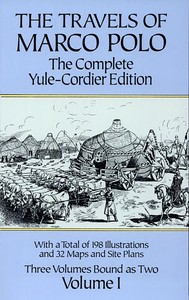
The Travels of Marco Polo — Volume 1 — A Closer Reading
(0 User reviews)
2002
Project Gutenberg
2004
Not confirmed
Voyages and travels; Asia -- Description and travel -- Early works to 1800; Mongols -- History; Polo, Marco, 1254-1323?
Readers of public-domain and historical texts
Project Gutenberg digital edition
en
Edition facts
Words
370,565
Reading time
1612 min
Text sections
60
This digital edition of The Travels of Marco Polo — Volume 1 — A Closer Reading is described by source-level measurements including 370,565 words, 26 hr 52 min estimated reading time, and 60 detected text sections.
The text analysis averages about 17.1 words per sentence, while the detected sections provide another way to judge how the source is divided.
Project Gutenberg metadata also associates the work with “Voyages and travels,” connecting these edition facts with the source record’s subject description.
Source:
Project Gutenberg record #10636
This editorial note examines how the opening, middle, and later excerpts of Marco Polo's Travels guide a first reading, focusing on the editorial apparatus, scholarly annotations, and the interplay between medieval narrative and modern commentary.
Read the complete public-domain text at its original source.
Read on Project GutenbergThe Yule-Cordier edition of Marco Polo's Travels opens not with Polo's own voice but with a dedication by Amy Frances Yule, a preface, and a medieval Italian poem from Brunetto Latini. This framing immediately signals that the reader is entering a layered text: Polo's account is mediated by centuries of scholarship. The dedication to Sir Roderick Murchison and the mention of proof sheets read under his roof ground the edition in a specific Victorian scholarly network. The inclusion of Latini's Il Tesoretto, with its catalogue of exotic animals and spices, echoes Polo's own enumerations and suggests the work's place in a tradition of wonder literature.
The Scholarly Apparatus as Guide
The first excerpt reveals that this is not a bare narrative but a heavily annotated edition. The table of contents, prefaces, and dedication prepare the reader for extensive footnotes and commentary. The note on Káshmir, for instance, draws on Chinese travellers, the Mahawanso, and modern scholars like Vassilyev and Bernier. This apparatus serves as a guide for first-time readers: it contextualizes Polo's observations within a broader historical and geographical framework. The editor's voice—comparing Polo's view of Káshmir as a Buddhist source to Firishta's phrase "foundry of magical superstition"—adds a layer of interpretation that the reader must navigate alongside Polo's own words.
Polo's Voice Amid the Footnotes
When Polo's own narrative appears, it is often embedded within the editor's commentary. The excerpt on Káshmir shows how Yule and Cordier use Polo's text as a springboard for extensive digressions on Buddhism, local history, and later travellers. A first reader may find Polo's original observations—such as his claim that Káshmir was the "very original source" of Mongol religion—almost lost among the notes. This structure demands an active reading strategy: one must decide whether to follow the footnotes immediately or read Polo's text straight through first. The edition thus becomes a conversation between the medieval traveller and his Victorian editors.
Recurring Motifs: Wonder and Enumeration
Both Polo's narrative and the editorial material share a fascination with lists and marvels. The opening poem by Latini enumerates gems, spices, and strange beasts—"tigri, e grifoni, leofanti, e leoni"—in a manner that prefigures Polo's own catalogues. Yule's notes similarly accumulate authorities: Chinese pilgrims, Persian historians, and European travellers. This recurring pattern of listing and comparing trains the reader to expect a text that moves between empirical observation and scholarly synthesis. The inclusion of Tennyson's lines on Odysseus further frames Polo as a wandering hero, linking his travels to classical epic traditions.
Navigating the Edition's Structure
The first volume contains over 370,000 words across 60 text sections, with extensive front matter and appendices. A first-time reader should note that the edition is organized by Polo's itinerary, with each chapter covering a region. The footnotes often contain the most vivid details—such as Bernier's description of Kashmiri women or the Chinese account of Hulaku's war. To avoid being overwhelmed, readers might begin with Polo's main text, using the notes as a secondary resource. The dedication and prefaces offer insight into the editors' motivations: Yule's translation aimed to make Polo accessible to a Victorian audience while preserving scholarly rigor.
This edition rewards readers who embrace its dual nature: it is both a medieval travelogue and a Victorian scholarly project. The interplay between Polo's voice and the editors' annotations creates a rich, if demanding, reading experience. For a first reading, consider focusing on Polo's narrative arc—his journey from Venice to the court of Kublai Khan—while dipping into the notes for context. The edition's structure, with its prefaces, footnotes, and appendices, mirrors the layered nature of Polo's own text, inviting repeated visits and deeper exploration.
Reading the annotations in The Travels of Marco Polo reminded me of sitting beside my grandfather, his finger tracing maps I couldn’t yet read. That feeling returned with English Travellers of the Renaissance — Inside the Classic, where scholarly notes become quiet companions, not interruptions. Both books let me linger between centuries, hearing older voices explain themselves gently, as if waiting for my patient attention.
There are no reviews for this eBook.
There are no comments for this eBook.
Reader reflection
What did you think of this book?
Answer a few questions and save a private reflection on this device.
Your progress
0
/
10
2
Was reading this book enjoyable?
3
Would you pass this book on to a friend?
4
Did the language feel accessible?
5
What was the strongest part of the book?
6
Was the book what you thought it would be?
7
How strong was your personal connection to the text?
8
How useful did the reading feel?
9
What is the main idea you are taking away?
10